

Conversation, Coffee & Communion | 101
Of Angels, Allegories, and Thelemic Angst
Conversation, Coffee & Communion is a monthly newsletter for paid subscribers that recommends a book and includes quotes from it. It also gathers interesting links from various sources related to exploring the world around us in a meaningful, intentional, and mindful way.
Do what thou wilt shall be the whole of the Law.
First, this issue of Conversation, Coffee & Communion is fully open to the public. Comments, as usual, remain possible only for paid subscribers.
Second, this review is special and important to me. The topic is one of the most controversial elements within all of Thelemic literature, and one that I’ve been railing on for the better part of three decades to what I always felt were unhearing ears and unseeing eyes. To me, this issue of the Holy Guardian Angel [HGA] was so clear the first time I read Magick: Liber ABA and Magick Without Tears. Everything else after that, published and unpublished by Crowley, merely confirmed my views. Marco does an excellent job of collating divergent information and spinning it into a narrative that finally makes sense to the average layperson. My hope is that his book (and his charismatic reputation) will help put a lot of the residual nonsense to rest.
Book Thoughts
I don’t often praise Thelemic books, but Marco’s Aleister Crowley’s Mysticism: A Practical Guide is at once fresh and dense. It is a welcome addition not only to his previous book, The Aleister Crowley Manual: Thelemic Magick for Modern Times, but also to the modern library of Thelemic literature.
Filled with insightful guidance on the mystical underpinnings and the A∴A∴ practices inspired by Thelema, Marco provides a timely corrective to the decades of O.T.O.-fueled superstitions plaguing Thelema since Crowley’s death. If I didn’t know any better—and I won’t say if I do or don’t—I’d think Marco was giving away practices and teachings of the A∴A∴ that haven’t been found outside direct communication from teacher-to-student in the past.
Crowley wrote that “Mystery is the enemy of Truth,” and, with a little nudging, I think he would agree that, in context, he meant “Secrets are the enemy of Truth.”
What’s the difference, you ask?
In Marco’s reading suggestions at the end of the book is the fantastic tome, anonymously published (though generally known to be Valentin Tomberg), Meditations on the Tarot, which includes this passage:
That which [the Major Arcana of the Tarot] reveal are not secrets, i.e. things hidden by human will, but are arcana, which is something quite different. An arcanum is that which it is necessary to “know” in order to be fruitful in a given domain of spiritual life. It is that which must be actively present in our consciousness—or even in our subconscious—in order to render us capable of making discoveries, engendering new ideas, conceiving of new artistic subjects. In a word, it makes us fertile in our creative pursuits, in whatever domain of spiritual life. An arcanum is a “ferment” or an “enzyme” whose presence stimulates the spiritual and the psychic life of man. And it is symbols which are the bearers of these “ferments” or “enzymes” and which communicate them […].
Just as the arcanum is superior to the secret, so is the mystery superior to the arcanum. The mystery is more than a stimulating “ferment”. It is a spiritual event comparable to physical birth or death. It is a change of the entire spiritual and psychic motivation, or a complete change of the plane of consciousness.1
I believe Marco pulls back the veil on much of the mystery (event) of the Knowledge and Conversation of the Holy Guardian Angel, but then he shatters the walls that have stupidly boxed in secrets (artificially controlled ideas) that have been hidden right out in plain sight, misunderstood by O.T.O. revivalists, and then taught so poorly that speculation and superstition rather than enlightenment have been the result. Frankly, I was trepidatious Marco’s approach would just be more O.T.O. derived bullshit. I’m happy to say: it’s not!
One thing I rarely say in public is that I agree with Marco’s disdain for religion if only because of one aspect that is pounded out in social critiques over and over again: that is, religion is about control. Certainly, I would add layers of qualifications to justify that Thelema is a religion that doesn’t seek control, but that would be a lie as well. The modern O.T.O. has taken that religious control to all new (or pathetically old?) heights. That includes turning this HGA process into a superstitious act reserved for “elite magicians” of the world.
This isn’t to say that I agree with every word Marco wrote. He knows better too. But he didn’t write this book for me. He wrote it for thousands of people who have been either curious but avoidant of the process or misled by the obfuscation of the talking heads who are blowing smoke up their asses.
If I’m honest, I think this book could have been twice the length and far more in-depth. But I also think it would have confused people who aren’t ready for the level of intensity—and simplicity—of this path Crowley left for us. There is a whole other layer to all of this that Marco skips entirely. And that’s just fine. We’re only 150 years into the present aeon, and we have time to play catch-up with the forces of this step-up in consciousness as we approach and eventually surpass the critical mass for such a process as the “Knowledge and Conversation” to be commonplace without all the handwaving, handwringing, and exceptionally verbose blather that goes on today.
Nearly all of Marco’s book is devoted to elucidating Crowley’s concepts of the mystical path from a more or less Thelemic perspective, with a special emphasis on the so-called “Knowledge and Conversation of the Holy Guardian Angel [HGA],” a concept that is as infuriatingly simple as it is misunderstood by those under the influence of O.T.O.’s organizational doctrines over the last fifty years.
Before we get started, I should warn you that my thoughts here are a mix of agreement and disagreement with Marco’s presentation—this is, after all, not a book review but the approximation of a “discussion among peers”—but don’t let any disagreement be mistaken for disrespect or disharmony. There is nothing here to assert authoritatively that Marco is wrong and I am right: in some places, we merely have different interpretations and different combinations of ideas that lead us to different conclusions. Two things can be true at the same time. In the places that I feel Marco is inaccurate or ‘less precise,’ I have provided my justification. (But I’m not going to write “IMO” or “in my opinion” over and over again; if you can’t figure that out, you need to be in a remedial logic class, not on Substack.) There is also no reason to suggest my analysis is better than his; it's just different. I am always open to revising my views based on evidence—it’s just that most of Marco’s evidence, with very minor exceptions, confirms what I’ve believed for decades, and that is most validating, to be honest, when one has felt very alone in their certainty.
Got your coffee? Good. As usual, I have some thoughts on this subject.
Pulled Quotes
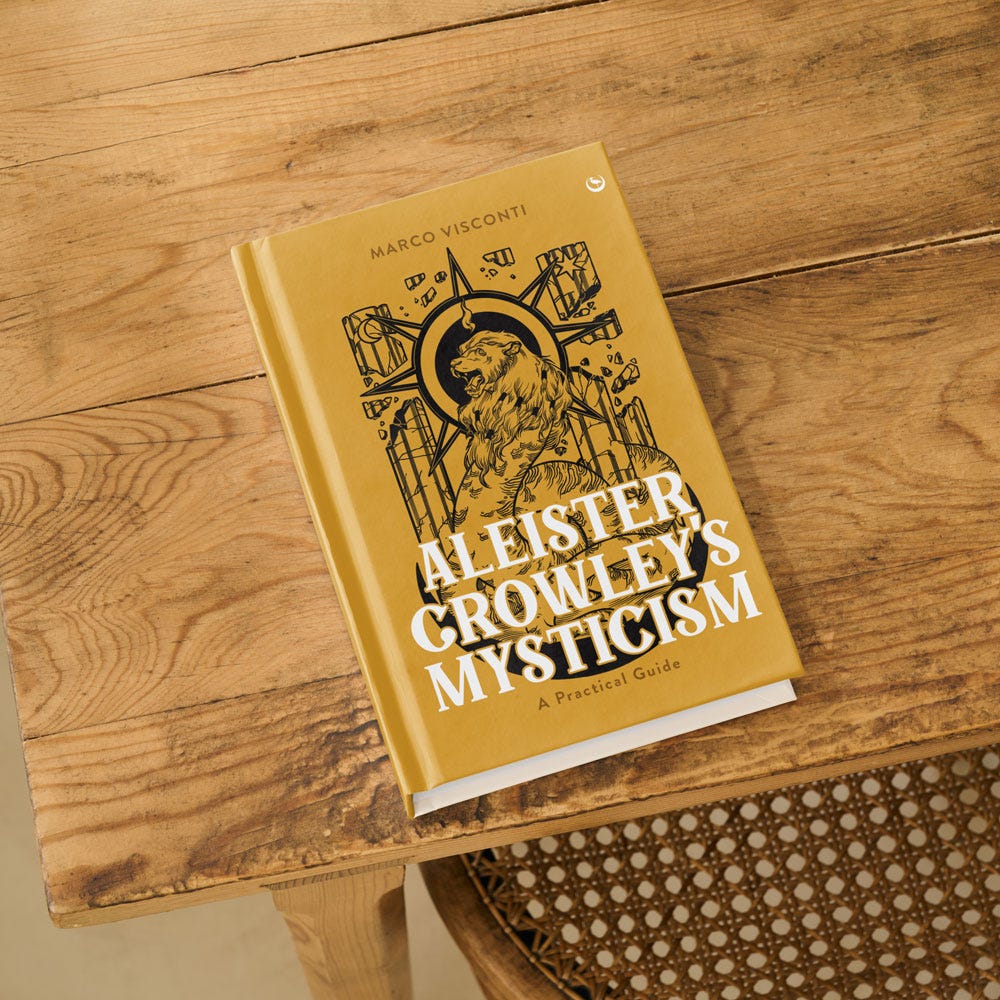
All quotes cited as ACM are from Marco Visconti, Aleister Crowley’s Mysticism: A Practical Guide. (Watkins Media Limited, 2025, Advance Reader Copy).
The essence of the HGA is that it is a deeply personal encounter in which only one’s own experience truly matters. Each individual’s journey is unique and should be respected. While it can be beneficial to encourage others to seek out their HGA, it is often unhelpful to dismiss others’ experiences as invalid simply because they did not follow a traditional approach or, worse, to claim their experience was negative due to not adhering to a preferred method. [ACM, 13, emphasis mine]
Most rely on snippets such as “none knoweth the Name of his brother’s God, or the Rite that invokes Him” from One Star in Sight to support such conclusions (while ignoring the rest of Crowley’s writings on the subject). And, to a large extent, this is truthful. Yet Crowley felt he was “able to promise any man or woman of average ability who has the germ of genuine aspiration, the essence of [the supreme] attainment within eight sessions.”2 He also claimed the “supreme emancipation”—the path toward which would include this HGA experience—“is the same in essence for all.”3 The end result is a predictable path for everyone, with infinite variety in how that path is expressed through each individual.
[T]here remains an unpredictable, variable element essential to these spiritual operations. This unpredictability is the individual performing the magic, which renders a scientific or rigidly controlled approach futile. Consequently, following precise instructions will not guarantee consistent results because your results are unique to you. This unpredictability should be embraced as it opens the door to new and unexpected experiences, adding a sense of intrigue and open-mindedness to your spiritual journey. [ACM, 14]
However, part of Crowley’s claim was that following his precise instructions would guarantee consistent results. But Marco isn’t wrong about the unpredictability aspect, the human aspect, the subtle and implicit biases that occur. Most people, especially those not in a science field, tend to forget about personal bias (or accuse others of bias while ignoring their own). But any good scientist-practitioner will work to minimize personal bias (otherwise, we wouldn’t have success in any scientific field). Why? Because ultimately, the HGA isn’t merely a more advanced “you,” and reaching for something like this requires intense dedication to avoid succumbing to your normal, everyday biases. (And, frankly, the formal A∴A∴ work helps with this too.)
[T]he third reason for the difficulty in discussing the Holy Guardian Angel lies in people’s divergent worldviews about the nature of existence. For an idealist who believes that the material realm is a product of the mind, the HGA as an aspect of the mind seems self-evident. However, for a realist who views the mind as a product of the material world, the HGA might be perceived as a separate, autonomous entity. [ACM, 14]
I find this helpful to point out, and I’m delighted Marco does quite clearly. However, this is part of the reason I believe the A∴A∴ system is not linear but cyclic.
Integral Theory via Wilber relies heavily on Spiral Dynamics developed by Don Beck and Clare Graves. From that perspective, every state of consciousness is only experienced from one’s individual stage of development. Seeing the HGA as “a product of the mind,” for instance, seems very “Green” (moving into “Yellow”) in nature—that is, it is not quite past the “mind is God” phase but still idealistic in how they view Other and holding on to a more subjective/relativistic worldview. Seeing the HGA as “a separate, autonomous entity” fits within a “Blue” or maybe “Orange” level because of its absolutist, rule-based approach and the materialistic nature of those worldviews (The so-called “spirit model” is merely a materialist worldview through a “spooky” lens).
There is no moral implication to any given level or stage. Children always start out in a developmentally “Beige” level; the instinctual “survive!” modes are kicked into overdrive at that point. Around age 2, they generally move into a “Purple” level, in the Piagetian sense of the preoperational development stage. It’s a very animistic-oriented way of cognitive and emotional processing. From there, around 7-8, the child begins to move into the “Red” stage and exhibits Koelburg’s preconventional morality, Freud’s early ego development, and the beginning of Piaget’s concrete operational stage. Here, children see authority figures as powerful, central, larger-than-life, and final—much as some religions posit anthropomorphic gods and spirits with these same familial qualities.
I could go on, but the point I want to make is that we don’t fault children for their early experiences and expressions of how they view reality around them. It’s a natural part of human development. Likewise, just because someone sees the HGA (or a god or a spirit or whatever) as an “external entity” is no reason to dismiss such an experience. They are only experiencing what their developmental level allows them to experience. As they mature, and assuming healthy development, such an experience will take on a more profound significance and meaning.
To be clear, the idea that the HGA (or a god or a spirit or whatever) is “all in your mind” isn’t the end of the road either. As that person continues to intellectually and spiritually mature, they too will find deeper meaning that goes beyond such an explanation.
Marco writes later in his book:
The Knowledge and Conversation of the Holy Guardian Angel is not simply a mystical experience, it is a fundamental shift in consciousness[.] [ACM, 245]
and
The visions or states resonate with the experiences one might encounter while attuned to the consciousness of their corresponding sephirah, depending on their grade within A∴A∴ [ACM, 65-66]
Marco acknowledges shifts in consciousness that occur through these experiences. While I would provisionally agree (and disagree, to be confusing) that each “sephirah,” or imaginary little circle on the Tree of Life model, is a different state (or stage) of consciousness, this offers a good stepping stone toward Crowley's assertion that the so-called “Crossing of the Abyss” is a fundamental shift in one’s stage of consciousness.
He says in Magick Without Tears:
Hindus may maintain that Atmadarshana, or at any rate Shivadarshana, is the equivalent of crossing the Abyss. Beware of any such conclusions! The Trances are simply isolated experiences, sharply cut off from normal thought-life. To cross the Abyss is a permanent and fundamental revolution in the whole of one’s being.4
He’s talking here about a shift in the stage of consciousness, not merely reaching a peak state of experience. Wilber suggests, in such a pithy manner, “States are free, structures [stages] are earned.”5 Any of us can attain any state of consciousness, but it’s temporary, and we will always interpret that state from the stage we currently inhabit. But to reach a stage of consciousness is permanent. Crowley understood this even if he didn’t have our same vocabulary.
I believe—and I think Marco is saying the same thing—that the HGA experience causes some kind of development in the stage of consciousness. It cannot help but transform you, taking you out of your current stage and setting you down into something beyond your current understanding of the world, the universe, and your self. Though I would argue, based on Crowley’s intimations, that the HGA is a shift within normal consciousness, and the experience “above the Abyss” is a shift within supraconsciousness.
Each time you reach a new stage of development, you reorient all the experiences you’ve had before (hence the cyclic nature of so-called “attainment”), and you are then capable of reaching those temporary states again and interpreting them in new ways. This is why I believe we see Crowley “crossing the abyss” multiple times—a little overlooked factoid in many texts (though it breaks the metaphysical foundation of the A∴A∴). But this is yet another reason why there has been no consistent or coherent ontological framework through Thelema qua Thelema to explain how these processes actually work. We’ve just assumed you “crawl up an imaginary Tree and find God.” But no one has ever offered an explanation of what that really means and why it matters beyond “Crowley [or some “ancient system”] said so.” In short, we’ve come to believe only the destination is important based on handed-down information from a bygone era when it’s really the journey after all.
While some Thelemites may argue that Crowley flirted with what they dismiss as the psychological model, it is clear that Crowley’s idealist framework should not be confused with a simplistic psychological interpretation. [ACM, 15-16]
If there is one thing that’s caused more than a bit of heartburn in the occult community—and is a huge pet peeve of mine both as an occultist and a psychologist—it is Tegtmeier’s Models of Magic essay from the early 1990s (though at the time it was novel and many, including me, thought it was a nifty perspective). To his credit, he states clearly, “[these] models of magic should be seen as a means of understanding the practical possibilities of various magical systems rather than as definitive theories and/or explanations of the way magic works.”6 Did anyone listen? Of course not.
Half the problem is that you have a shit ton of people who write books and social media posts with “magick isn’t psychological,” and another shit ton of midwit occultists pumping out “because anything psychological is of the mind,” and neither statement is accurate. Magick absolutely is psychological. And psychology absolutely is more than the mind.
Any honest individual (especially a psychologist) will tell you that the definition of psychology is “the study of behavior and mental processes.” Read that slowly if you’re confused by all those big words.
If you wave your wand in the air (like you just don’t care)—that’s a behavior—it falls into the realm of psychology. If you’re examining altered states of consciousness (or even suprarational stages of consciousness)—which falls under the general category of mental processes—it’s psychology. If you’re doing it with shrooms, it’s still psychology. If you’re exploring the cultural influences that shape your biases, it’s absolutely psychology. If you’re working to determine the best leadership structure for your community, yup, you guessed it, that’s also psychology! It’s just that fucking simple.
I could go on at length on this, but I say all this because, again, Marco is right to criticize this so-called “psychological model” or approach. Yet, as he mentions in his own way, it’s not as simple as proclaiming, “it’s all in your head [mind]; you just don’t know how big your head is.”
As an aside, Marco has an amazing video (at this link) that I think offers some great insight into this subject.
Aleister Crowley’s views on the Holy Guardian Angel evolved throughout his life, oscillating between seeing it as an internal aspect of the self and eventually as something external. In Magick Without Tears, particularly in Chapter 43, Crowley firmly asserts that the HGA is not merely an abstraction of oneself or a ‘higher self.’ This later stance, which I personally agree with, reflects Crowley’s lifelong refinement of his ideas. [ACM, 16n6, bold emphasis mine]
This is one of the few things that genuinely makes me twitch. Crowley never “changed his mind” about the Holy Guardian Angel. In fact, one of the last comments he ever made about the nature of the HGA, in a letter to Friedrich Lekve in 1946 [for those who like that whole “later writings are more better” fallacy], was that “it” is an expansion of human consciousness and, once we understand this, “we can do without the need to assume the existence of another being (that is to say, that of the Guardian Angel).” Granted, I admit it sounds simplistic when we write it out as such, but the reality isn’t that simple at all. However, this “Crowley switched to an external entity” is just more batshit gleaned from the “LAM is one of those Little Green Men” crowd.
In short, Crowley tailored how he discussed the HGA to his audience—and, of course, those views certainly matured over the decades—but underlying all his explanations, the consistency of what he was talking about never changed. In modern (integral) parlance, we could say it appears Crowley intended for the HGA to be described as exterior (ontological) rather than external (physical). And even that sounds far more complicated than it should, yet it falls within some of the most cutting-edge work in the field of consciousness being done today.
More to the point: the HGA is one of the most stable topics in Crowley’s corpus.
What Marco leaves out, and someday I’ll return to this topic, is that the HGA is an “Old Aeon” concept that is neither required nor accounted for in the “New Aeon.” Our current aeon does not use the “formula” of the slain and rising god, which is the formula of the HGA according to Crowley. This is not to say the old formula doesn’t work—it does—but Crowley is clear it is “for those who have not yet assimilated the point of view of the Law of Thelema.” Neither magick nor mysticism is required for this “attainment” of the HGA in the current aeon—and Crowley is quite direct about that too.
Upon the dissolution of the ego, one establishes a connection with the True Self, a principle that transcends the boundaries of life and death, and is thus eternal and infinite. […] It is important to emphasize, however, that although we employ the term ‘ego’, these transformations should not be construed solely as psychological processes. Rather, they signify ontological shifts that surpass the domain of the empirical mind. [ACM, 26, 28]
I am rather thrilled that Marco put this in writing. It’s another of my pet peeves: “ego.” Western occultism, or at least our “modern” version of it, doesn’t know what the fuck “ego” even means. They’ve robbed an already poor translation of Freud, twisted it to mean something Freud never intended, and then taken it to all new heights of absurdity with the addition of poorly understood Eastern concepts.
I’ll leave it at that for now, but when we talk about the “ego” in Thelema, especially in relation to mysticism, we are most definitely talking about “ontological shifts” of consciousness rather than segments of personality. We just need a better term than “ego.”
I am not, however, going to bitch at every use of “ego” in Marco’s text. I’ll just seethe in silence and move on because I know what he means.
Crowley’s emphasis here is that the true self […] is ever-present and unaltered. […] By navigating through these stages, one doesn’t become something entirely new but rather returns to the original, pure state of being, now enriched with awareness and understanding.
The journey from ignorance to enlightenment underscores the Thelemic principle that every individual is inherently divine. The process is less about acquiring new qualities and more about rediscovering and embracing the eternal truth that has always resided within. [ACM, 33, bold emphasis mine]
I think my only issue here is the concept of “return” or “rediscovering” something that is heavily influenced by the nomenclature and iconography of the previous aeon via the Tree of Life. This aligns with the “ladder back to God” metaphor I criticize regularly.
Admittedly, I’m struggling to articulate all this in a way that makes (better) sense—and I think Crowley struggled with it too—but the core of Thelema is that we’re not returning to anything, but that we already are some “thing” (Nuit) and that thing has variously incarnated (as whatever we want to call it: Hadit, self, Khabs, star, etc) to go through changes (via experience/union) in the particular and individual configuration that happens at birth. The paradox of Thelema is that each of us is that one thing (union, “agape,” participation) and not merely a piece or spark or quantum of the whole, while still retaining a sense of individual identity (division, “thelema,” resistance).
This process that Marco explains is about further elucidating our way through this experience of existence for the sake of change (union). But that doesn’t require the HGA experience. We already do this naturally to a large extent—but it’s more like aimless “winging” that could get us to our destination(s) eventually. But with the HGA, there is an intentionality to our comings and goings.
That all said, I have never read a better explanation of this process than the one Marco offers throughout this book.
And so here’s a major revelation for you: Thelema’s higher achievements aren’t magical, they’re mystical. The Holy Guardian Angel’s Knowledge and Conversation equate to union with God and perfection in non-duality[.] [ACM, 44, emphasis in original]
I provisionally agree with the first sentence. I disagree entirely with the second sentence. I’m not going to get into the weeds on this for space reasons, but the difference between the experiences of the Angel and the Abyss is a matter of an ontological alignment of the Will. In the former, the interior informs the exterior; and in the latter, the exterior conforms to (is reconstellated by) the interior—both experiences are “union,” but one is stage informed by a state [and, yes, possibly a new stage as well, though still well within “normal consciouness”] and the other is a state transformed into a stage. As Crowley writes—and I quoted earlier—the Abyss is a major shift in consciousness at a core level. Not that the HGA isn’t major, but it’s the difference between “the highest of the highest” of normal consciousness (which most people never reach in the first place) versus even the most rudimentary supraconsciousness.
And, technically, the traditional understanding of “crossing the Abyss” isn’t “union with God” either—according to Crowley (ironically, you can see this in Marco’s book reproduced from 777 on page 67), though I would argue from the position of the Book of the Law [AL 3.62–67] that it is “union with God.” I know. I can be confusing sometimes. That said, most of this is Crowley’s fault for using the same nomenclature for various experiences without discriminating between them.
As an aside, keep in mind—something else that Marco didn’t cover—is that the “attainment” of the HGA also has a failure mode. And it’s not just “I didn’t ‘get it’ so I’ll try again later.” There is the HGA. Then there is its opposite. According to Crowley, attainment of the Angel, much like the Abyss, only goes one of two ways. The HGA is absolutely a spiritual crisis and not merely a vector of consciousness. But two things can be true at the same time: so it’s both, quite frankly.
… Thelema’s soteriology – the path to transcendence, enlightenment, and the reclamation of one’s stellar heritage. [ACM, 45]
I’m going to (mostly) disagree with Marco again. Thelema’s soteriology [i.e., doctrine of salvation] isn’t transcendent (or reclaimant)—unless you’re examining Thelema from the position and perspective of the previous aeon (Spiral Dynamics: Red/Purple/Blue). To be clear again, there’s nothing wrong with that perspective. Even Crowley tells us most people will still be utilizing the previous aeon’s perspective for some time to come. But it’s not the perspective of this aeon (Spiral Dynamics: Green/Yellow), as Crowley writes in several places.
Though I do love the term “stellar heritage.” I am so stealing that!
However … [ACM, 51]
I realize I’m cheating by only including one word here, but I chuckled when I reached this point. Seeing Marco confess that devotion has a place in the mystical-magical world of Thelema was worth the entire book. Yes!
That said, I entirely agree with his caveats:
… practices almost invariably devolve into mindless repetition of empty rituals and keep up the delusion of the vicarious atonement of the previous Aeon of Osiris – that is, the idea that if we pray strongly enough, some sort of Sky Daddy (or Mommy, or anything in between or beyond) will come and save us and give us candies. [ACM, 51]
Which is why Thelemic devotional practices require intentional behaviors, as he then goes on to point out with one of my absolute favorite texts, Liber Astarte vel Berylli sub figura CLXXV.
After that, Marco doesn’t hold back, and I’m glad to see it.
It’s helpful to consider the Angel as an external being while aspiring to Knowing and Conversing with them. In its fundamental nature, the Angel is not a tangible being or object. It is how things or objects are created. It embodies the essence of existence rather than representing a specific entity. Thus, the Angel, in the end, cannot be objectified under any circumstances. The Angel is not encountered as an independent entity. The Angel is one. In the words of the Anthem of the Liber XV: the Gnostic Mass: ‘Thou that art I, beyond all that I am.’ [ACM, 84, bold emphasis mine]
And there it is, clearly, in black and white. Finally. Took him 84 pages to get there. I’m not sure how anyone who appreciates the O.T.O. Gnostic Mass could miss it.
I honestly think the quote says it all, so moving on.
I am not going to quote it in full, but I will point out that Marco does an amazing job of breaking down the “Charge to the Spirits” on page 95. There are a couple of things I think I disagree with, but I’m not sure if I actually disagree or if it’s just a lack of understanding of some details I think are missing from his explanation. It’s minor and I almost didn’t even bring it up, but I think that overlooking this breakdown and seeing it for what it is, as Marco has provided it, would be tragic. My confusion or disagreement, either way, is immaterial to its value—even to me. I learned a lot specifically in this section.
However, this journey is not linear. It is a spiral ascent, with each revolution bringing greater insight and deeper integration of the Divine within the self. [ACM, 243-244]
It’s about time that we start to see this process in the same way as any other kind of human development: cyclic (or spiral, as Marco calls it). If you think you’ve made it to the end of the journey, you haven’t. It’s just getting ready to start again. But this is part of the problem with models designed around emanationist ideologies: they make it about the destination, not the journey. Their apocalypses are catastrophic endgames rather than successive change.
As we have explored, the Angel is more than just a spiritual guide – it is the very essence of the True Will, the spark of divinity within each individual. [ACM, 245]
If he’d only stopped with “essence of True Will” …
I get why people write like this. It’s comforting. But Crowley specifically tackles this when he writes, “[W]e are warned against the idea of a Pleroma, a flame of which we are Sparks, and to which we return when we ‘attain’.”7 One of the glitches of the Guntherian sect of Thelema is its reliance on the “spark of God” approach in direct contravention of the Book of the Law. This goes back to the paradox of Thelema: a part that is the whole that is a part.
In recent years, we’ve witnessed a proliferation of readymade online gurus, each claiming the attainment of the Holy Guardian Angel as a badge of spiritual authority and a means to secure social capital. This trend is particularly noticeable within Thelemic circles, where countless individuals echo the various accounts read in this or that book or podcast. It’s curious – and, frankly, hard to believe – that so many people report having had exactly the same experience, even down to their wives leaving them, a seemingly very common experience. [ACM, 247-248]
I burst out laughing at this. This is like the superstition of the III° O.T.O. initiation that life would implode in some terrible way. But he’s so right: it’s like many of these high-faluttin’ “adepts” reach this summit of attainment, of harmony and balance, and they suddenly end one of the most important relationships in their lives (and almost inevitably pick up a “younger model”). Exceptions exist, of course.
Some, having attained the summit of Adeptus Exemptus (7°=4□), refuse the final surrender. They approach the abyss not with reverence, but with resistance. […] But between the lesser self and the greater self lies the abyss – a gulf of unknowing that must consume the ego. The adept must die, mystically, and be reborn as no one – Nemo – whose consciousness is emptied of selfhood and filled only with the Word of the Law. […] They cling to their personal identity, magical attainments, or vision of control, and in so doing, fall – not downward, but inward – into a sealed and shrinking shell of their former light. […] the Black Brother is not a failed novice, but a failed master. They have passed through fire and storm, only to collapse into themselves, becoming a monad closed to the cosmos. […] The Black Brother is not a metaphor, nor a symbol. It is a real ontological danger within the magical path. [ACM, 249-250]
I love that Marco used the word “resistance” here. Granted, I disagree with the “fall … inward” comment, but only because I think the Book of the Law has established in all this—and Crowley was this close to getting it too—that we’re not talking higher/lower or even lesser/greater (which is also a reflection of Jerry Cornelius’ “Dueling Banjos” approach) and foists an inaccurate view of our duality.
Thelema posits two basic modes of existential experience: resistance (division) and participation (union). Our individuality is created through our resistance to “the whole,” to a withdrawal from participation with the whole. “For I am divided for love’s sake, for the chance of union” [AL 1.29]. It is through this resistance that our existence and identity are formed, while union becomes the rhythm of change by which the Star both defines (includes) and develops (transcends) itself.
However, conditions of this so-called “crossing the Abyss” are about “giving up all aspects of individuality [resistance]” and, as Marco writes, this is the first step in becoming a “Master of the Temple (8°=3□), whose Will is united with the all” [ACM, 249]. But I think Marco has this straight on here. It is the refusal [resistance] to unite [participate] in the nature of the whole cosmos that creates the so-called “Black Brothers,” those who have refused to fall into the embrace of the cosmos itself, shutting themselves up [again, resistance] as darkness in the face of that universal light. It is the ultimate betrayal of participation, of union.
My only real disagreement with the “inner” notion is ontological; that is, to fall inward is to fall toward Hadit, to the center of the star—see Thelemic Cartography—and to shed the exterior forms, to achieve a kind of death (to “know Hadit” is a state of Witness, a death of the exterior [ontological] elements). This is precisely the mode of the Adept as they cross the abyss: dead to all they were and had become—including the union with their Holy Guardian Angel—so that they may be nothing more than ash (or stardust?) in the cosmos to be reconstellated for (re)union with the Adept left behind.
Overall, I feel that Marco has conflated the “union with one’s God” [gold, AL 3.65, cf. “One Star in Sight”] with the “union with God” [stones of precious water, AL 3.66].
Crowley writes
[T]he “vision of God,” or “Union with God,” or “samadhi,” or whatever we may agree to call it, has many kinds and many degrees, although there is an impassable abyss between the least of them and the greatest of all the phenomena of normal consciousness.8
In my view, the experience of the HGA falls within “the greatest of all the phenomena of normal consciousness” (which is still beyond our understanding of “daily, normal consciousness”)—and in this is the key and the promise of Thelema as “the essential Work of every man”9—while those supranormal states and stages of consciousness reside “above the abyss,” as it were. This is yet another reason why “above the Abyss” is for so very few.
As we move forward, it is essential to remember that the path to Heliopolis is not a solitary one. While the journey is deeply personal, it is also part of a larger cosmic process – one that connects us to the Divine and to each other. Thelemic mysticism invites us to embrace this interconnectedness, to see the Divine in all things and to act in accordance with the highest principles of love and will. [ACM, 251, bold emphasis mine]
I’m thrilled to see Marco acknowledge the role of community, even if I’m stretching his words to suit my own narrative. I’ve mentioned before, the spiritual experience may be individual, but community is what keeps spirituality from delusion.
Thelema invites us to see this interconnectedness, to participate in it, to find our union in all experiences, and to grow from them. Marco offers a clear and robust look at the mystical path. I, for one, am grateful for his clarity on such a complex subject.
That’s all!
I want to stress what I mentioned at the start of this meandering through Marco’s book: disagreement should not be interpreted as disharmony. Too many in our community enjoy pitting people against each other over imagined slights that are merely reasonable and irenic differences, even within researched and informed opinions (though I hope our differences won’t keep Marco from writing my book’s epilogue once the time comes).
I continue to recommend The Aleister Crowley Manual, and I think Aleister Crowley’s Mysticism is a fantastic follow-up.
Until next time,
Love is the law, love under will.
—Johnathon Victor Reese
Anonymous. 2020. Meditations on the Tarot: A Journey Into Christian Hermeticism. Angelico Press, 4 (bold emphasis mine)
Crowley, Aleister. 1989. The Confessions of Aleister Crowley: An Autohagiography. Edited by John Symonds and Kenneth Grant. Arkana, 239
Crowley, 1989. The Confessions of Aleister Crowley, 240
Crowley, Aleister. 1994. “The Left-Hand Path—The Black Brothers” In Magick Without Tears. New Falcon Publications, 112 (emphasis mine)
Wilber, Ken. 2017. The Religion of Tomorrow: A Vision for the Future of the Great Traditions—More Inclusive, More Comprehensive, More Complete. Shambhala Publications, 216
Emphasis mine. (You can find the original here: http://www.chaosmatrix.org/library/chaos/texts/model.html)
Crowley, Aleister. 1996. The Law Is for All: The Authorized Popular Commentary to Liber AL vel Legis sub figura CCXX, the Book of the Law. Edited by Louis Wilkinson and Hymenaeus Beta. New Falcon Publications, 32
Crowley, Magick, 14
Crowley, Magick, 494